Why Small Businesses Struggle with Office Relocations
Relocating a business is fundamentally different from moving a household. When you’re shifting an office, timing isn’t optional, systems matter more than sentiment, and downtime directly impacts revenue. Yet many London small business owners treat their office move like a residential relocation, which typically leads to disruption, lost productivity, and frustrated staff.
We’ve worked with hundreds of businesses across London and beyond, and we understand the specific pressures you face. This guide walks through what makes commercial moves challenging, how to evaluate moving partners, and how to plan a relocation that keeps your business running smoothly.
Small business owners juggle countless responsibilities. Adding an office move to that list often feels overwhelming because the stakes are high and the variables are numerous.
Most small businesses underestimate the planning window required. A residential move might take 4-6 weeks to organize. Commercial relocations typically need 8-12 weeks of coordination, especially if you’re moving sensitive equipment, large furniture systems, or coordinating with multiple departments. When businesses compress this timeline, quality suffers.
Staff coordination adds complexity that home moves don’t require. You need to keep some people working during the move, communicate with IT about system transitions, brief teams on new workspace layouts, and manage the emotional aspects of change. Coordinating this alone while running your business creates bottlenecks.
Equipment sensitivity is another critical factor. A residential mover experienced in sofas and wardrobes may not understand how to safely transport servers, multifunction printers, networked systems, or specialized machinery. One miscalibrated move can corrupt data or damage equipment worth thousands.
Finally, many small businesses lack detailed floor plans and asset inventories for their current space. Without knowing exactly what you own, where it sits, and its dimensions, moving companies can’t provide accurate quotes or timelines. This creates surprises on moving day that cost time and money.
Next step: Start your relocation planning at least 10-12 weeks before your target move date. Create a basic inventory of major furniture and equipment pieces to share with potential movers.
The Real Cost of Choosing the Wrong Moving Partner
Selecting a moving company based on price alone is one of the most expensive shortcuts you can take. The hidden costs of a poorly executed commercial move often exceed the savings from choosing a cheaper option.
Consider what happens when a moving company arrives understaffed or unprepared. A team that should take 5 hours takes 12. During those extended hours, your staff sits idle, customers may go unserved, or critical systems remain offline. For a business billing by the hour or operating on thin margins, this costs far more than a higher upfront moving fee.
Data security represents another invisible risk. If your moving partner doesn’t follow proper protocols for handling computers, servers, or devices containing sensitive information, you expose the business to data breaches, compliance violations, or intellectual property loss. The cost of a single data incident typically runs into thousands of pounds, not to mention reputational damage.
Equipment damage is tangible but often underestimated in cost. Moving a £15,000 server incorrectly doesn’t just mean repair or replacement. It means downtime, IT emergency calls, potential data recovery expenses, and lost business continuity. Inadequate insurance or lack of accountability leaves you absorbing the full cost.
Poor coordination also leads to repeated visits or partial moves. If items are left behind or placed in the wrong location, you’re paying for additional trips and staff time to sort it out. Some businesses find themselves paying 30-40% more in total moving costs than originally quoted because of these inefficiencies.
Action item: When evaluating moving partners, ask for references from at least three previous commercial clients and clarify what their insurance covers for equipment damage and data security incidents.
What Sets Our Commercial Moving Services Apart
At Quickshift Removals, we approach every commercial move as a business continuity project, not just a transportation job. Our team has spent years learning what London small businesses actually need from a moving partner.
We specialize in office relocations specifically. This means our staff understands IT equipment requirements, knows how to coordinate around business operations, and has developed protocols that minimize disruption. Unlike general movers, we ask the right questions upfront: Where are your servers? Do you have networked printers? What’s your tolerance for system downtime? These details shape our entire plan.
Our detailed planning process happens well before moving day. We conduct site visits to both your current and new location, document your layout and equipment, and create a move timeline that works with your business schedule. Some clients need a weekend move; others prefer evening hours when staff has left. We accommodate these constraints because we know they matter.

We invest in the right equipment for business moves. This includes climate-controlled vehicles for sensitive electronics, proper server transport containers, specialized dollies for heavy furniture systems, and protective wrapping designed for professional equipment. Cutting corners on equipment shows up immediately in risk and execution quality.
Our team training focuses on commercial-grade professionalism. Staff understand how to handle confidential documents, respect restricted areas, work around active businesses, and communicate clearly about progress and challenges. This professionalism reduces anxiety on your end and helps staff feel secure during the transition.
Our removals and storage services also include secure facilities for items you need to stage before installation at your new location. This flexibility lets you move on your timeline, not under artificial time pressure.
Our Tailored Approach to London Business Relocations
Every business move is different, and we’ve learned that a one-size-fits-all approach creates problems. Our process starts with understanding your specific situation.
We begin with a detailed discovery conversation. We ask about your business type, the nature of your equipment, your IT infrastructure, how many staff will be involved, and your ideal moving timeline. We also ask about any previous moving experiences or concerns. This conversation typically reveals details that shape the entire strategy.
Next, we conduct on-site assessments at both locations. We measure doorways, identify load-bearing capabilities in your new space, check parking and access constraints, and note any special requirements like climate control for equipment or secure areas for sensitive materials. This takes 1-2 hours but prevents costly surprises.
We then create a customized move plan with a detailed timeline. This plan specifies which items move when, who supervises which areas, how IT systems transition, and what staff coordination is needed. We share this plan with you for feedback and refinement before we execute it.
For IT-heavy businesses, we often coordinate directly with your internal IT team. We understand that servers can’t just be unplugged and transported. We build in proper shutdown procedures, secure transport protocols, and careful reinstallation timelines. Some clients ask us to move IT equipment after hours to minimize system downtime, and we schedule accordingly.
We also account for London-specific challenges. Parking in congested areas requires advance permits. Narrow staircases in converted warehouse buildings need specialized planning. Historic properties have movement restrictions. We factor these in from the start rather than encountering them on moving day.
Practical takeaway: Share your IT infrastructure details with your moving company at least 6 weeks before the move. Provide floor plans of both locations, access restrictions, and any equipment with special handling requirements.
Minimizing Downtime with Our Professional Planning Process
Downtime during a commercial move directly costs you revenue and productivity. Our planning process specifically targets reducing this impact.
We work backward from your target moving date to build a realistic timeline. If you need to be operational in your new space by Monday morning, we plan the move for the preceding Friday and Saturday. If you can stagger the move across multiple days, we schedule it around your business hours. The timeline must work with your operations, not against them.
We typically recommend a phased approach for larger moves. Rather than relocating the entire office at once, we might move departments sequentially. This keeps parts of your team productive while others transition. For example, a 20-person office might move 5 people per day across four days, maintaining service delivery throughout.
Communication is critical to minimizing downtime. We provide daily progress updates, notify you of any issues immediately, and coordinate with your team about what’s happening and when. When staff knows the plan and understands the timeline, they’re less anxious and more cooperative.
We also build buffer time into our schedules. If we estimate 6 hours for a move, we schedule 7. This accounts for unexpected complications without creating last-minute pressure that extends actual downtime. The extra hour is an insurance policy you’re unlikely to need.
For businesses with critical IT systems, we coordinate move timing with IT staff to ensure proper system transitions. We might disconnect computers in the late afternoon, transport them overnight, and have them reconnected and tested by early morning. This approach keeps downtime to hours rather than days.
Next step: Create a detailed business continuity plan with your IT team before the move. Identify which systems are critical, in what order they need to come online, and who’s responsible for each transition step.
How We Handle Your Sensitive Business Equipment and Data
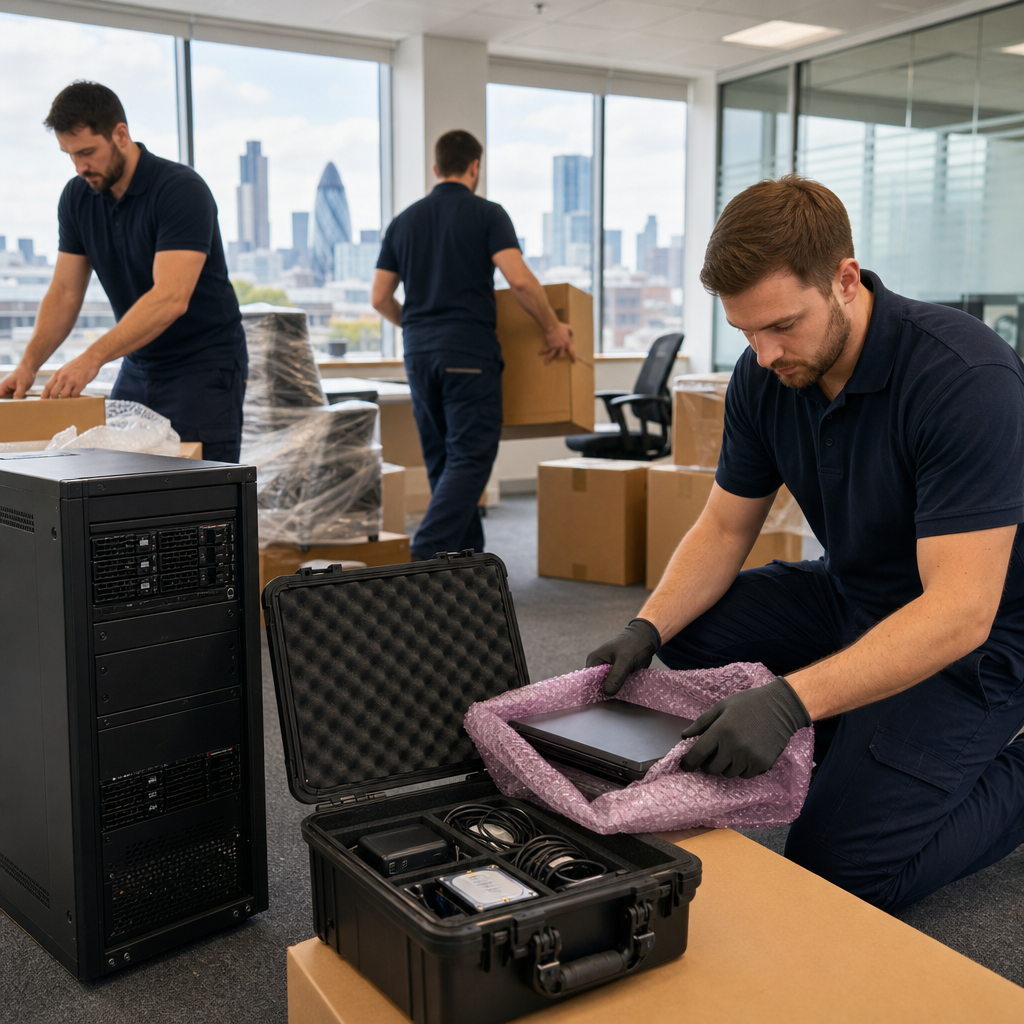
Equipment safety and data security aren’t negotiable in commercial moves. We’ve built specific protocols around these concerns.
We treat all devices containing data as high-risk items. Servers, computers, networked printers, and external drives are packed separately, transported in climate-controlled vehicles, and marked for careful handling. We don’t treat these like standard office furniture because the consequences of damage or improper handling are far greater.
Our team follows industry-standard protocols for device transport. Servers are secured in specialized containers that prevent movement and protect against impact. Computers are powered down properly, cables are labeled and secured, and nothing is packed in ways that risk component damage. We understand that a £40 cable properly secured prevents a £3,000 equipment repair.
We also maintain chain-of-custody documentation for devices containing sensitive data. Your IT team can request a record of which devices were transported, when, and who handled them. This documentation supports compliance requirements and provides security assurance.
For businesses with confidential documents, we offer secure document handling. Files are packed in locked boxes, transported in secure vehicles, and unpacked only by authorized personnel in your new location. We don’t open or view document contents; we maintain the confidentiality chain from start to finish.
Our team signs confidentiality agreements as standard practice. This legal protection covers any information our staff might incidentally observe during the move. Combined with our screening process, it means you’re working with trustworthy professionals.
We carry insurance specifically covering commercial equipment and data security incidents. While we aim never to need it, this coverage protects you if something unexpected happens despite our precautions.
Action item: Document the serial numbers and specifications of your critical equipment before the move. Provide this list to us and your IT team so everyone’s working with the same asset inventory.
Our International Expansion Support for Growing Businesses
London businesses often grow into international operations, and relocation frequently coincides with expansion. We support both local and international moves for clients at this stage.
We coordinate with international moving partners for businesses expanding to Europe, Asia, or North America. Rather than managing separate moving companies, you work with us as a single point of contact. We handle local London logistics and coordinate with trusted partners abroad for the international leg. This unified approach reduces confusion and ensures consistent service standards.
International moves require additional planning for shipping documentation, customs compliance, and international transportation standards. We guide you through these requirements and handle the coordination. We also account for the extended timeline involved in shipping goods internationally, which typically takes 4-8 weeks depending on destination.
We’ve worked with businesses expanding to European cities like Paris, Amsterdam, and Berlin, as well as further afield to Singapore and Sydney. Each location has specific requirements, and our experience helps you navigate them efficiently.
For businesses moving some staff internationally while keeping operations in London, we coordinate split relocations. Perhaps your leadership team moves to a new international office while core operations remain in London. We manage both transitions simultaneously.
We also provide storage solutions for businesses managing split locations temporarily. If you’re opening a new office before your London lease expires, you might need interim storage for some equipment and furniture. Our secure storage solutions let you stage items until your new space is ready.
Planning consideration: If you’re expanding internationally, begin discussions with your moving partner 12-16 weeks before your target move date. International logistics add complexity that requires extended planning windows.
Secure Storage Solutions for Your Transition Period
Not all businesses can move entirely in one transition. Many need flexible timing, phased relocations, or temporary storage between moves. Our secure storage facilities support these scenarios.
Our storage units are climate-controlled and monitored 24/7. For businesses storing IT equipment, office furniture, or valuable items, this environmental control matters. Temperature and humidity fluctuations damage electronics and warp wooden furniture. Our facilities maintain consistent conditions year-round.
Security is built into our storage operations. Units are accessed via keycard, monitored by cameras, and staffed during business hours. Only authorized personnel can access your items. We also track inventory, so you always know what’s in storage and can request specific items when needed.

Pricing is flexible based on duration. Whether you need storage for 2 weeks, 2 months, or longer, we structure pricing to match your timeline. Many businesses find that paying for interim storage is far cheaper than rushing a move and disrupting operations.
We’ve seen businesses use storage strategically. A common scenario: move items to storage on Friday, spend the weekend setting up your new space, then move items from storage to the new location as space becomes available. This phased approach reduces stress and keeps your team from feeling overwhelmed by chaos.
Storage also solves the problem of uneven move timing. If your current lease ends on June 30 but your new space isn’t ready until July 15, storage bridges that gap without forcing compressed moving timelines that create problems.
Practical option: If your business move extends beyond one day, discuss interim storage options with your moving partner. It often proves cheaper and less disruptive than alternatives.
Our 24/7 Support Ensures Nothing Goes Wrong
Commercial moves sometimes encounter unexpected challenges. Our 24/7 support availability means you’re never dealing with problems alone or without expert guidance.
We provide direct contact information for a dedicated point person on your move. If something goes wrong during the move, you call them immediately. We don’t put you in a phone queue or make you wait until business hours. Issues get addressed in real time while the move is happening.
Our support team can authorize on-the-spot adjustments. If unexpected access challenges emerge, our team can make decisions without waiting for approval. If an item needs careful repositioning mid-move, our supervisor can direct the team immediately. This responsiveness prevents small issues from becoming major problems.
Post-move support is equally important. Once your business is in the new space, our team follows up to confirm everything arrived as expected and that systems are functioning properly. We’re available if you discover something missing or misplaced, and we coordinate resolution quickly.
We also provide guidance on final setup in your new space. Our team can advise on equipment positioning for optimal IT connectivity, furniture arrangement to suit your workflow, and any adjustments that might improve your new workspace functionality.
Our moving FAQs address common questions, but for issues unique to your situation, direct contact with our team ensures personalized support.
How to use this: When you engage our services, ask for direct contact details for your dedicated move coordinator. Know that you can reach someone immediately if problems emerge during or shortly after your move.
Why London Businesses Trust Our Removals Team
Trust in a moving company is earned through consistent execution and genuine care for client outcomes. We’ve built that trust across hundreds of London businesses.
Our team includes staff with 5, 10, and even 15+ years of commercial moving experience. They’ve handled moves of every type: startups relocating for the first time, growing companies scaling to larger offices, and established businesses seeking better locations. This experience means anticipating problems before they occur.
We maintain strong relationships with London’s business community. References from previous clients represent our best marketing. Businesses recommend us to colleagues because they’ve experienced our professionalism directly.
We also invest in our team continuously. Training covers new equipment handling techniques, changing data security standards, and evolving customer service expectations. Our team stays current because the moving industry changes, and we adapt with it.
Our operations are transparent. You know who’s moving your belongings, what they’re trained in, and how we’re insuring your items. We don’t hide behind corporate layers. You speak directly with the people managing your move.
We recognize that commercial moves are stressful. We approach each one with the assumption that your business is important and that your time matters. This perspective shapes how we plan, execute, and follow up on every project.
Getting started: Contact our main London office to schedule a free consultation. We’ll discuss your specific relocation needs and provide a customized plan before you commit to anything. For typical commercial moves, we can provide detailed quotes and timelines within 48 hours of your initial consultation.
Your business move doesn’t have to be chaotic. With the right planning partner, it becomes a managed transition that keeps your operations running smoothly while positioning you in a better workspace.